

The Daily Decision Digest: 13 July 2026

There were 56 appeal decisions yesterday, allowing permission for up to 205 residential units in Blaby, Hounslow, Huntingdonshire and Stafford – the decisions featured below cover issues including housing land supply, National Landscape protection, Green Belt and grey belt traveller provision, industrial and logistics need, solar development, Class MA prior approval and protected-species evidence.
Blaby: 200 homes allowed in a Green Wedge
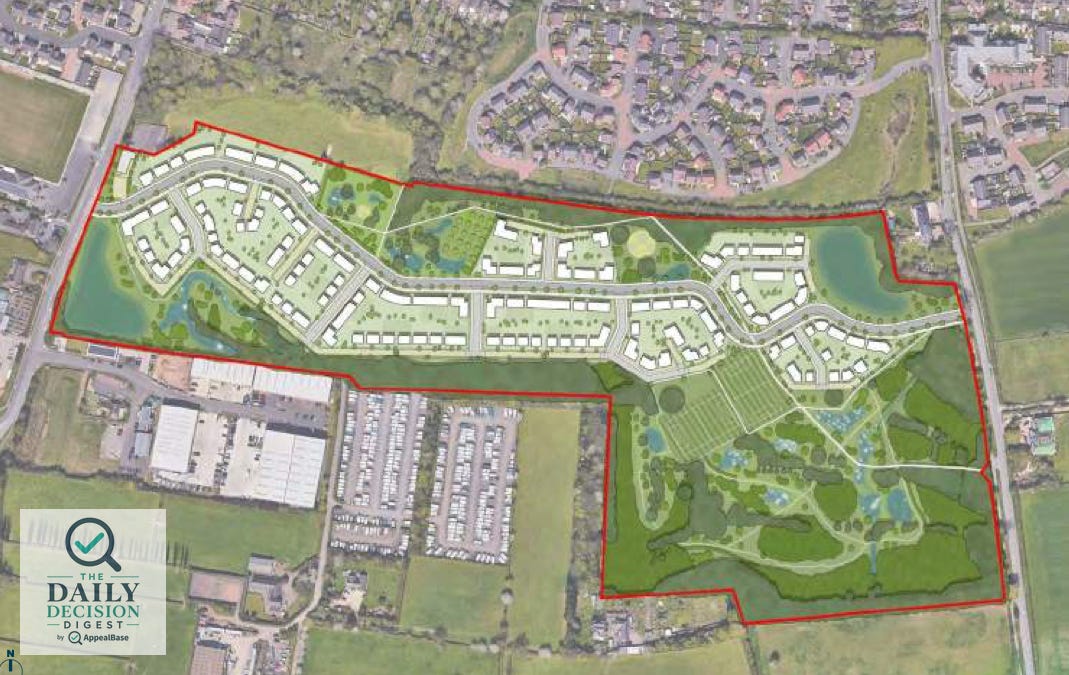
An inquiry allowed up to 200 dwellings at Blaby Golf Range. The Inspector found very limited harm to the Green Wedge, conflict with recreation policy through the loss of golf facilities, and conflict with the settlement boundary, but concluded that the site was one of the most sustainable locations and that the benefits of market and affordable housing in the context of a 2.78-year supply carried considerable weight. The decision is notable for its treatment of Green Wedge policy as requiring a balance against housing need rather than operating as an absolute constraint. (6004284)
Stratford-on-Avon: Logistics need outweighed substantial landscape harm
A hybrid scheme for industrial, logistics and research and development floorspace south of M40 Junction 12 was allowed after an inquiry despite the Inspector finding a “truly very great” harmful effect on landscape character and appearance. The decisive factor was the substantial and immediate need for industrial and logistics land in South Warwickshire, the lack of short- to medium-term plan-led alternatives, and the site’s prime motorway location. (6002929)
Stroud: National Landscape harm defeated a 73-home scheme
A 73-dwelling scheme in Dursley was dismissed at inquiry despite a 3.24-year housing land supply and substantial weight being given to both market and affordable housing. The Inspector found harmful effects on local character and on the setting of the Cotswolds National Landscape, including views to and from the escarpment and tranquillity. National Landscape policy provided a strong reason for refusal under paragraph 11(d)(i), showing the continuing force of protected landscape policy even where housing need is acute. (6002408)
Tandridge: Two traveller appeals apply the updated Green Belt framework
Two hearing decisions allowed traveller sites at Blindley Heath. At Heathview, the site was treated as previously developed land and the proposal did not cause substantial harm to Green Belt openness, so it was not inappropriate development. At Winnie’s Woodland, the Inspector found the site to be grey belt land, accepted that the Council could not demonstrate a five-year supply of deliverable traveller sites, and rejected the alleged cumulative domination of the settled community. The decisions are significant for how the revised Framework and PPTS apply to traveller proposals. (6002345, 6002255)
South Kesteven: Solar benefits outweighed local landscape and heritage harm
A 38.78MW AC solar farm near Welby was allowed for a temporary 50-year period. The Inspector found harm to landscape character, cumulative solar effects, less than substantial harm to the Grade II listed Oasby Mill and Oasby Conservation Area, and limited harm to a non-designated farmstead. Those harms were outweighed by renewable energy generation, lower-cost energy, biodiversity net gain and economic benefits, with the decision underlining the weight being given to renewable energy where impacts are localised and capable of management by condition. (6007057)
Hounslow: Class MA allowed in a conservation area mews
Prior approval was granted for conversion of Class E floorspace in Turnham Green Terrace Mews to two dwellings. The Inspector held that the GPDO did not require regard to the development plan, considered conservation area impacts only within the Class MA prior approval framework, and found no harm to the character or sustainability of the conservation area because the building was in a quiet mews, lacked an active shopfront and was vacant. (6006483)
West Lancashire: Affordable housing benefit did not cure protected-species gaps
An outline scheme for 10 affordable houses at Hesketh Bank was dismissed despite a 1.86-year housing land supply. The Inspector gave reduced weight to the protected land sequential policy conflict and found flood risk could be managed, but dismissed the appeal because the evidence was insufficient to establish the effect on water voles and their habitat. The absence of a section 106 agreement also meant only limited weight could be given to the claimed affordable housing benefit. (6005633)
Bath and North East Somerset: WHS, flood risk and ecology defeated a small housing scheme
A six-dwelling scheme at Hicks Field, Bath was dismissed following a non-determination appeal. The Inspector found harm to the Bath Conservation Area and City of Bath World Heritage Site, loss of green infrastructure, failure of the sequential test for flood risk, excessive parking, an inappropriate housing mix and insufficient evidence on bats, the SAC and biodiversity net gain. The decision is a reminder that small housing schemes in highly constrained urban-edge sites may fail on cumulative policy conflicts even where the authority lacks a five-year housing supply. (6002997)
Search the full text of all PINS appeal decisions for free at www.appealbase.com